
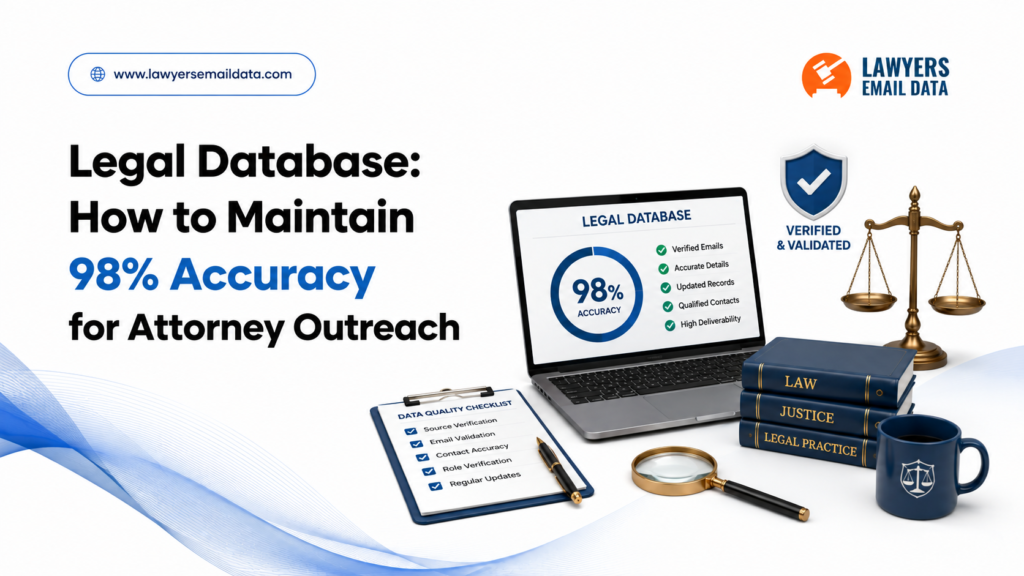
The 98% accuracy benchmark is not marketing language. It is the operational floor that separates campaigns that land from campaigns that quietly destroy your sending infrastructure over time.
You send a cold email campaign to 5,000 attorneys. Three hundred bounce. Your domain reputation takes a hit. The next batch lands in spam. Two weeks of pipeline work, gone.
This is not a hypothetical. It is what happens when marketers run outreach against an unverified attorney email list. Legal prospecting carries a higher data risk than almost any other B2B vertical, because the legal sector moves faster than the databases built to track it.
- Why Do Legal Databases Decay Faster Than Other B2B Sectors?
- Can You Rely on Bar Association Directories and Pre-Packaged Lists?
- How Do You Achieve and Maintain 98% Accuracy in an Attorney Email Database?
- How Do You Protect Deliverability Against Enterprise Law Firm Security Filters?
- What Does a Well-Maintained Legal Email Database Actually Deliver?
- Data Quality Is Not a Pre-Campaign Checkbox
- Common Questions About Attorney Email List Accuracy
Why Do Legal Databases Decay Faster Than Other B2B Sectors?
Most B2B databases lose 20-25% of their accuracy per year. For the legal sector, that figure trends higher, consistently.
Partner lateral moves, firm mergers, associate attrition, and domain-level rebranding events combine to invalidate up to 30% of legal contact records within a single year, making standard annual refresh cycles insufficient for campaign-grade accuracy.
Senior attorneys shift between firms regularly, particularly in high-competition practice areas like M&A, IP litigation, and private equity advisory. When a partner moves, their email address changes, their domain changes, and their firm affiliation shifts simultaneously.
Law firms, particularly large Am Law 200 practices, experience significant associate turnover. First and second-year associates who do not make the cut to senior associate exit quickly. High volumes of junior contacts turn invalid before many campaigns have even completed their first sending cycle.
When two firms combine, hundreds of attorney email addresses can change domain simultaneously. A contact database purchased three months before a merger goes partially invalid the moment the firms announce a new joint entity and migrate to a unified domain.
Promotions from associate to counsel, counsel to partner, or non-equity to equity status affect how contacts are categorized and, in some cases, how they appear in firm directories. Lists built on stale title data produce poor segmentation accuracy even when the email address itself is technically still active.
The combined effect of these forces means that a legal email list which is not continuously maintained is not an asset. It is a liability with a deliverability countdown.
Can You Rely on Bar Association Directories and Pre-Packaged Lists?
Bar association directories were built to confirm licensure, not to support outbound email deliverability.
They verify that an attorney is admitted to practice but do not confirm whether a corporate email address is active, monitored, or even associated with a current role, making them unsuitable as a primary source for cold outreach without significant additional validation.
The directories are accurate for one purpose: confirming that a lawyer is in good standing with their state bar. They were not designed to support high-volume outbound email campaigns, and using them as a primary data source produces predictable failures.
Directories frequently surface shared inboxes (info@, contact@, reception@) rather than verified personal attorney inboxes. These accounts rarely convert and reliably drag engagement metrics downward.
A directory refreshed annually cannot capture the pace of lateral moves, firm mergers, and attorney departures happening quarter over quarter. The record shows an attorney’s last known practice affiliation, not their current one.
Directory entries confirm professional existence, not inbox health. There is no syntax validation, no MX record check, and no active mailbox confirmation embedded in the underlying data.
Pre-packaged attorney lists built from directory scraping inherit these same weaknesses at scale. You are not purchasing a verified legal email database. You are purchasing a contact roster that may have been accurate six to twelve months ago, before any of the structural events described above occurred.
Ready to work with a properly verified list?
Talk to a Data SpecialistHow Do You Achieve and Maintain 98% Accuracy in an Attorney Email Database?
Maintaining near-98% accuracy requires a four-stage verification framework – from syntax hygiene through to quarterly re-verification cadences calibrated to the legal sector’s specific decay patterns.
Before any email address enters an active campaign, it passes through format-level hygiene checks. This means standardizing firm domains across common naming variations (lawfirm.com, lfllp.com, lawgroup.com, firmname.legal), catching typographical errors introduced during data entry, and identifying duplicate records that may carry conflicting information about the same contact.
This step is routinely underestimated because it appears administrative. A domain suffix error or a transposed character in an email address can misdirect an entire sending batch and trigger spam classification before a single message is read.
Syntax hygiene confirms that an address is correctly formatted. Active mailbox validation confirms that it is live.
Law firms are heavy users of catch-all server configurations, where the mail server accepts all incoming messages at the domain level regardless of whether the specific mailbox exists. This creates a meaningful verification blind spot: a standard bounce test will return a clean result for an address that does not actually work.
Advanced verification handles this through risk scoring combined with deep mailbox pinging protocols. Contacts that cannot be confirmed as actively monitored are flagged and suppressed before they reach a sending queue.
Hard bounces are a permanent signal. Any email address that returns a hard bounce should be immediately and permanently removed from all active sending queues, with no re-entry without fresh verification.
Automated suppression goes further by monitoring soft bounces in sequence. When a contact generates two consecutive soft bounces within a defined window, they move to a re-verification queue rather than continuing to receive sends.
Every send to an invalid address erodes your domain reputation by a measurable increment. Behavioral suppression catches that erosion at the early-signal stage, before it becomes a structural deliverability problem.
Even a well-maintained attorney email database requires scheduled re-verification at the contact level. For the legal sector specifically, quarterly re-verification is the minimum viable cadence for active campaign lists. Annual scrubs are insufficient given the rate of lateral moves and firm-level events.
Quarterly verification means running the active contact list through mailbox validation and behavioral checks every 90 days, flagging contacts that have gone dark, and refreshing records where a domain change or firm-level structural event has occurred.
Long-term campaigns that skip this cadence typically see bounce rates climb from acceptable to campaign-threatening within two to three sending cycles, at precisely the point when the campaign should be generating its highest returns.
How Do You Protect Deliverability Against Enterprise Law Firm Security Filters?
A verified attorney contact database is necessary for legal sector outreach. It is not sufficient on its own.
Large law firms run enterprise-grade email security infrastructure that filters cold outreach based on sender reputation, authentication signals, and engagement history. Aligning data hygiene with technical authentication protocols is a required step before sending to high-security legal domains, regardless of how clean the contact list is.
The full deliverability chain requires your sending infrastructure to be correctly configured before outreach to Am Law-tier firms reaches inboxes. Three authentication elements are non-negotiable.
Your SPF record must authorize every IP address sending on your behalf. Misaligned SPF is among the most common reasons cold outreach to corporate law firm domains routes to quarantine or is silently dropped.
DKIM adds a cryptographic signature to every outbound message. Enterprise security tools at large firms verify this signature at the gateway level before routing inbound messages to individual attorney inboxes.
A published DMARC policy instructs receiving mail servers on how to handle messages that fail SPF or DKIM checks. Senders without a DMARC record are treated as lower-trust senders across large US and international law firms.
Data quality and technical authentication are interdependent. A list at 98% verified contacts sent from a domain with misaligned authentication still faces significant deliverability risk against high-security legal targets. Both dimensions need to be addressed before any legal sector campaign is considered ready to send.
What Does a Well-Maintained Legal Email Database Actually Deliver?
A rigorously maintained attorney email database typically sustains hard bounce rates below 0.5% – the threshold that protects sender domain reputation during legal sector campaigns.
The difference between a verified legal contact database and an unverified one does not show up in the contact count at purchase. It shows up in campaign outcomes.
- Hard bounce rates held below the 0.5% threshold that email service providers use as a reputation risk marker
- Active, monitored inboxes rather than role-based catch-all accounts that rarely reach an attorney’s personal attention
- Current job title and practice area data that supports meaningful segmentation, not historical categorization that predates a firm’s last structural event
- Accurate firm domain records, including post-merger domain changes that invalidate contact records built on pre-merger data
- Segmentation-ready attributes covering practice area, seniority level, firm size, geographic region, and specialization – without relying on stale or unverified classification
The investment in data quality recovers itself in deliverability protection before any conversion metrics are considered. Protecting a sender domain from bounce-triggered reputation damage is, by itself, a significant return on the verification infrastructure.
Request Your Verified Attorney Email Database Sample
See the data quality difference before you commit. Segmented by practice area, seniority, firm size, and geography.
Request Verified SampleData Quality Is Not a Pre-Campaign Checkbox
Legal prospecting is not simply about having attorney contact data. It is about having attorney contact data that survives the send.
The legal sector’s structural fluidity – from partner lateral moves to firm mergers to enterprise-grade security filters – creates a uniquely demanding environment for data accuracy. Standard B2B data practices do not transfer to this vertical without modification.
The four-step framework covered here, covering syntax hygiene, active mailbox validation, behavioral suppression, and quarterly re-verification, represents the operational minimum for maintaining an attorney email list that consistently delivers below a 0.5% bounce rate.
Data quality is not a pre-campaign checkbox. In legal sector outreach, it is the campaign infrastructure.
Common Questions About Attorney Email List Accuracy
The legal industry experiences frequent structural changes including partner lateral moves, firm rebranding, mergers, and high associate turnover. Contacts change domains or exit practices rapidly, causing static lists to lose up to 30% of their validity within a single year. Ongoing verification is essential for maintaining campaign-grade accuracy in this vertical.
To protect sender domain reputation and avoid being flagged by email service providers, hard bounce rates should remain below 0.5%. Campaigns targeting corporate law firm domains with enterprise security filters are particularly sensitive because repeated delivery failures trigger spam classification that affects all subsequent sends from the same domain.
No. Public directories confirm professional licensure but do not verify active, monitored corporate inboxes. Relying on directory-sourced data typically produces elevated bounce rates due to outdated records, role-based generic accounts, and the absence of any deliverability-level validation. Directories are a credentialing resource, not a campaign-ready contact source.
Advanced verification applies risk scoring and deep mailbox pinging to separate high-confidence inboxes from catch-all servers. This process isolates attorney contacts likely to receive and engage with outbound messages, rather than flagging entire firm domains as unverifiable. Only contacts passing a deliverability confidence threshold should enter an active campaign queue.
For active outbound campaigns in the legal sector, quarterly re-verification is the recommended minimum cadence. The pace of lateral moves, firm mergers, and associate turnover makes annual scrubs insufficient to maintain accuracy at the level required for sender reputation protection across extended campaign cycles.
B2B email outreach to professional contacts, including attorneys at their business addresses, generally falls within permissible-use frameworks under regulations such as CAN-SPAM in the United States. Compliance responsibility rests with the sender. Responsible outreach practices, including accurate sender identification, functioning opt-out mechanisms, and active suppression of unsubscribe requests, are required independent of the data source.
A verified attorney contact record should include: full name, direct business email, law firm name, practice area, seniority level (associate, counsel, partner, equity partner), geographic location, and firm size. Records that lack current practice area and seniority data limit segmentation precision and reduce personalization effectiveness across campaign touchpoints.
A lawyer email list is a contact file organized by industry category. A verified attorney database is a continuously maintained repository where every record has passed multi-stage validation including syntax checks, MX record verification, active mailbox confirmation, and behavioral suppression. The verification layer determines whether a list is campaign-ready or simply organized contact data with no deliverability guarantee.