
Legal marketing has become more competitive than ever. Legal technology companies, professional service providers, recruitment firms, financial organizations, and business solution providers are investing heavily in campaigns designed to reach attorneys and law firms. Yet many organizations face the same challenge: their campaigns generate activity, but not enough qualified conversations.
Emails are sent. Contacts are added to databases. Outreach campaigns are launched. Yet response rates remain low, sales teams struggle to identify genuine opportunities, and marketing budgets fail to deliver the expected return.
In many cases, the problem is not the marketing strategy itself. The problem is the quality of the data supporting that strategy.
A legal marketing campaign can have the right message, the right offer, and the right timing but if it reaches outdated contacts, irrelevant professionals, or individuals without purchasing authority, the campaign performance will suffer regardless.
More contacts do not always create more opportunities. A database containing thousands of inaccurate or irrelevant records can reduce email deliverability, increase campaign costs, and waste valuable sales resources. On the other hand, a smaller database containing verified lawyer contacts and relevant decision-makers can create stronger engagement and better conversion opportunities.
This is why data quality has become a critical factor in legal lead generation. Businesses that successfully market to the legal industry understand that accurate information, proper segmentation, and targeted outreach are essential for improving marketing ROI.
Why Data Quality Matters in Legal Lead Generation
The legal industry is not like a general B2B market. Law firms operate across hundreds of specialized practice areas, and the needs of one legal professional can be completely different from another. A corporate attorney, personal injury lawyer, healthcare lawyer, and intellectual property attorney may all work in the same industry, but their priorities, challenges, and purchasing decisions can vary significantly.
For businesses offering solutions to legal professionals, reaching the right audience requires precision. A legal technology provider selling case management software needs to identify law firms that are actively looking for operational improvements. A legal education provider may need to reach attorneys interested in continuing education programs. A recruitment agency may need access to partners, associates, and hiring managers.
Without accurate legal marketing data, these businesses risk spending resources reaching people who are unlikely to become customers. High-quality data helps organizations understand:
- Which legal professionals they should target
- Which practice areas are most relevant to their solution
- Which firms match their ideal customer profile
- Which decision-makers influence purchasing decisions
- Which markets provide the strongest opportunities
Reaching the Right Legal Decision-Makers
One of the biggest challenges in legal prospecting is identifying who actually makes business decisions within a law firm. A law firm may have dozens or hundreds of employees, but not every professional has purchasing authority. Depending on the solution being offered, relevant contacts may include:
| Role | Why They Matter |
|---|---|
| Managing Partners | Primary decision-makers for firm-wide investments |
| Law Firm Partners | Influence practice group purchases and technology adoption |
| Founders | Control strategic and operational decisions at smaller firms |
| Practice Group Leaders | Drive purchasing for their specific legal specialty |
| Legal Operations Executives | Oversee technology, workflow, and efficiency projects |
| Office Administrators | Manage vendor relationships and operational tools |
| Technology Decision-Makers | Evaluate and approve legal tech solutions |
| Business Development Professionals | Influence marketing and growth-related purchases |
A generic database that only identifies lawyers by profession does not provide enough insight. Successful legal marketing requires deeper segmentation based on factors such as job role, practice area, firm size, and location.
Why Generic Databases Often Fail for Legal Marketing
Many businesses rely on broad professional databases that combine multiple industries into one large contact pool. While these databases may contain thousands of records, they often lack the details needed for effective legal outreach.
A lawyer is not simply a lawyer. A solo practitioner handling family law cases has different needs from a partner at a multinational corporate law firm. Similarly, a criminal defense attorney may have little interest in the same solutions that appeal to a corporate legal department.
Without proper legal industry segmentation, businesses often send irrelevant messages to the wrong audience resulting in lower engagement, poor response rates, increased email fatigue, and reduced campaign effectiveness.
The legal industry contains many specialized practice areas, each requiring a distinct targeting strategy:
Accurate legal data allows marketers to move beyond broad targeting and create campaigns designed around specific audiences. When outreach matches the professional’s specific practice area and needs, engagement becomes more meaningful.
How Poor Data Quality Impacts Legal Marketing ROI
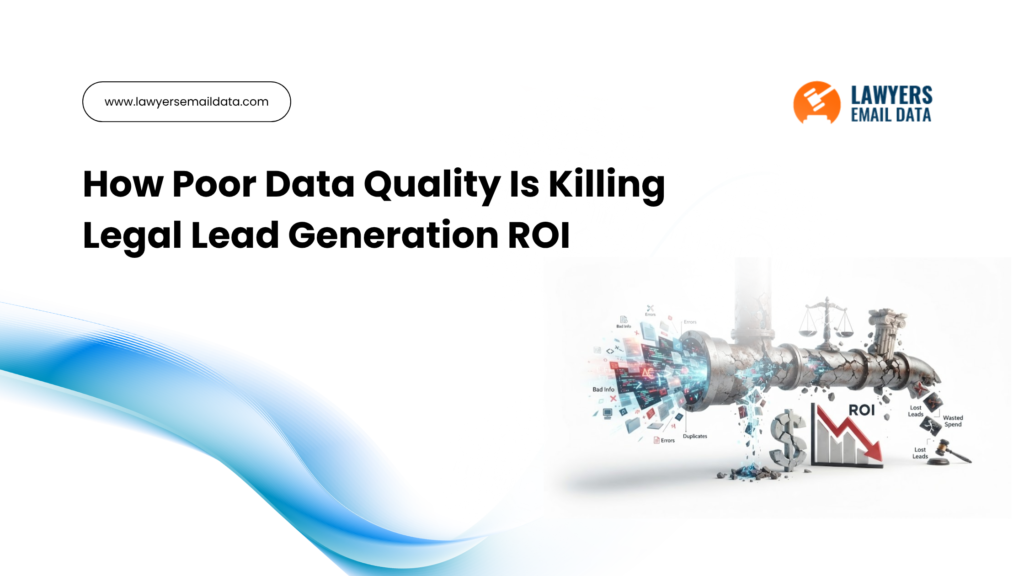
Poor-quality data does not always create immediate problems. Many businesses discover the impact later, after investing time and money into campaigns that fail to generate meaningful opportunities. From reduced deliverability to inefficient sales outreach, inaccurate data affects every stage of the marketing process.
Outdated Attorney Information Reduces Campaign Effectiveness
Legal professionals frequently change firms, move into new roles, open new practices, or leave organizations. A contact database that is not regularly updated quickly loses value. An email address belonging to an attorney who changed firms two years ago may result in failed email delivery, messages reaching the wrong organization, lost sales opportunities, and reduced sender reputation.
Outdated job titles create another challenge. A campaign targeting managing partners may accidentally reach former partners, retired attorneys, or professionals who no longer influence purchasing decisions. These small data inaccuracies can significantly impact campaign performance.
The Impact of Poor Data on Email Deliverability
Email deliverability plays an important role in successful legal outreach. When campaigns contain inaccurate email addresses, bounce rates increase. High bounce rates can affect sender reputation and reduce the likelihood that future messages reach the intended audience.
Improve email deliverability, reduce wasted outreach, maintain campaign efficiency, and reach active legal professionals. Data accuracy is not just about having more records. It is about having records businesses can confidently use.
Poor Data Creates Low-Quality Leads
Many businesses measure lead generation success by the number of contacts collected. However, contact volume does not always represent business opportunity. A list of 20,000 legal professionals may appear valuable, but if most contacts are irrelevant, inactive, or outside the target market, the actual value is much lower.
A smaller group of verified legal decision-makers can often deliver better results than a large database with limited accuracy. Quality consistently outperforms quantity in legal lead generation.
Inaccurate Data Increases Marketing Costs
Poor-quality data does not only affect campaign performance. It also increases the overall cost of acquiring new customers. When businesses use inaccurate legal contact information, they spend money on campaigns that reach the wrong audience or fail to reach anyone at all. Every unsuccessful outreach attempt creates hidden costs: marketing teams spend additional time cleaning databases, sales representatives spend hours researching contacts manually, and campaign managers invest more budget generating leads that may never become qualified opportunities.
Common Legal Marketing Data Mistakes Businesses Make
Many businesses understand the importance of targeting legal professionals but still make common data-related mistakes that reduce campaign performance. Identifying these issues is the first step toward improving legal lead generation results.
Using Generic Professional Databases
A general B2B database may include lawyers, consultants, executives, and professionals from multiple industries. While this may appear useful, it often lacks the detailed information required for effective legal targeting. Legal marketing requires knowing which practice area an attorney specializes in, what type of law firm they work with, where the firm operates, and whether they influence purchasing decisions.
Ignoring Legal Practice Area Segmentation
A campaign targeting all attorneys with the same message often produces weak engagement because the communication does not address the audience’s actual needs. A compliance software provider may find stronger engagement among healthcare attorneys and corporate law firms than among unrelated legal specialties. Practice area segmentation allows businesses to create more relevant campaigns and improve conversion potential.
Focusing Only on Volume
A common misconception in lead generation is that a larger database automatically creates better results. A database containing 10,000 generic attorney contacts may generate fewer qualified conversations than a smaller database containing 1,000 verified legal professionals who match specific campaign requirements. Successful legal marketers focus on quality rather than quantity.
Not Updating Contact Databases Regularly
Attorneys move between firms. New partners join practices. Firms expand into new locations. Professionals change responsibilities. A database that was accurate a year ago may contain outdated information today. This is known as data decay. Regular database updates and verification help maintain data quality and improve long-term marketing performance.
How Successful Legal Marketing Teams Improve Data Quality
Successful legal marketing teams understand that better results come from better data practices. They do not rely on assumptions. Instead, they create structured processes that improve targeting, personalization, and campaign efficiency.
They Define Their Ideal Legal Audience
Before launching any campaign, successful organizations clearly define who they want to reach. They identify characteristics such as legal specialty, geographic market, law firm size, job role, and business requirements. This helps businesses avoid unnecessary outreach and focus resources where they have the highest potential.
They Use Verified Attorney Databases
Accurate data creates a stronger foundation for marketing campaigns. Verified attorney databases help businesses connect with active legal professionals using reliable contact information. Instead of spending time questioning whether contact information is accurate, marketing teams can focus on creating valuable campaigns that improve email deliverability, targeting accuracy, and prospecting efficiency.
They Segment Campaigns Based on Business Goals
Effective legal marketers do not use a one-size-fits-all approach. They create targeted campaigns based on specialty, geography, and firm size. Location-based targeting helps businesses reach law firms in specific regions or countries, especially valuable for organizations expanding into new markets.
They Personalize Outreach
Personalization is one of the strongest factors influencing B2B engagement. Successful legal marketers avoid generic messages and focus on relevant business challenges. Effective personalization includes mentioning specific practice areas, addressing industry challenges, highlighting relevant solutions, and creating messaging based on the recipient’s role.
When legal professionals receive communication that reflects their actual needs and practice context, they are significantly more likely to engage and respond.
How Lawyers Email Data Helps Improve Legal Lead Generation ROI
Improving legal marketing performance starts with reaching the right professionals. At Lawyers Email Data, we help businesses connect with verified legal professionals through targeted and segmented legal contact databases. Our focus is providing accurate legal industry data that supports organizations looking to reach attorneys, law firms, and legal decision-makers.
We provide:
- Verified lawyer email lists
- Segmented attorney databases
- Law firm contacts
- Practice-area targeting
- Geographic filtering
Businesses can customize their data requirements based on legal specialty, location, firm size, job title, and professional roles. This allows marketers to build campaigns that match their exact outreach goals.
Our legal databases are developed using a multi-step verification process designed to improve accuracy and reliability. This includes contact verification, data validation, database updates, and quality checks. The goal is simple: help businesses improve outreach accuracy, reduce wasted marketing efforts, and connect with relevant legal professionals.
Whether you are a legal technology provider, recruitment company, marketing agency, or professional service provider, having access to reliable attorney data helps create more focused and effective campaigns.
Practical Checklist to Improve Legal Lead Generation Performance
Improving legal lead generation performance does not always require increasing your marketing budget or creating more campaigns. In many cases, better results come from improving the quality of the data, targeting strategy, and outreach process behind your existing campaigns.
-
Define Your Target Legal AudienceConsider legal practice area, geographic location, law firm size, professional role, business needs, and decision-making authority before launching any outreach campaign.
-
Identify the Right Decision-MakersBefore building your outreach list, identify managing partners, law firm owners, practice group leaders, and legal operations professionals who actually influence purchasing decisions.
-
Verify Attorney Contact InformationEnsure current email addresses, updated job titles, and correct law firm details before starting campaigns. Regular verification reduces bounce rates and wasted marketing expenses.
-
Segment Contacts Based on Legal SpecialtiesGroup contacts by practice area to create messages that directly connect with the audience’s professional needs and specific business challenges.
-
Improve Campaign PersonalizationTailor messaging to practice area, firm size, business goals, and professional role. A message designed for a corporate law firm should differ from communication for solo attorneys.
-
Monitor Email Deliverability and Engagement MetricsTrack bounce rates, open rates, click-through rates, response rates, and conversion rates. High bounce rates often signal outdated data, not poor copy or weak offers.
-
Track Lead Quality, Not Just Lead QuantityFocus on qualified conversations, pipeline contribution, and conversion rates. A smaller relevant list consistently outperforms a large generic database.
-
Update Your Legal Database RegularlyAttorneys move, firms change, and roles evolve. Regular maintenance keeps outreach accurate and effective over the long term.
Conclusion
Poor legal lead generation ROI is rarely caused by a lack of marketing effort. Many businesses invest significant time and resources into campaigns but struggle because they are working with inaccurate, outdated, or poorly segmented data.
A successful legal marketing strategy depends on reaching the right professionals with the right message at the right time. Accurate information, relevant segmentation, and personalized communication allow businesses to build stronger connections with legal decision-makers.
Organizations that prioritize data quality can improve campaign efficiency, email deliverability, lead qualification, sales productivity, and overall marketing ROI. The goal of legal lead generation should not be collecting the largest number of contacts. It should be creating meaningful opportunities with legal professionals who are relevant to your business.
By investing in verified legal data and targeted outreach strategies, businesses can build more effective campaigns and create a stronger foundation for long-term growth.