
Attorney Database vs. Contact Database
Two data products. Both reach attorneys. But they’re built for different campaigns. Choose the right format — and your outreach lands.
Choosing between them isn’t about which one is better. It’s about which one fits what you’re actually trying to do. If attorneys are your entire audience, you need one thing. If attorneys are one segment inside a larger campaign, you need something else.
Get the match right and your outreach lands. Get it wrong and you either over-engineer a simple campaign or under-equip a complex one. This guide explains both products, where each performs best, and a five-step process for building a targeted attorney contact list from either format.
What Is an Attorney Database?
An attorney database is a data product built exclusively for the legal sector.
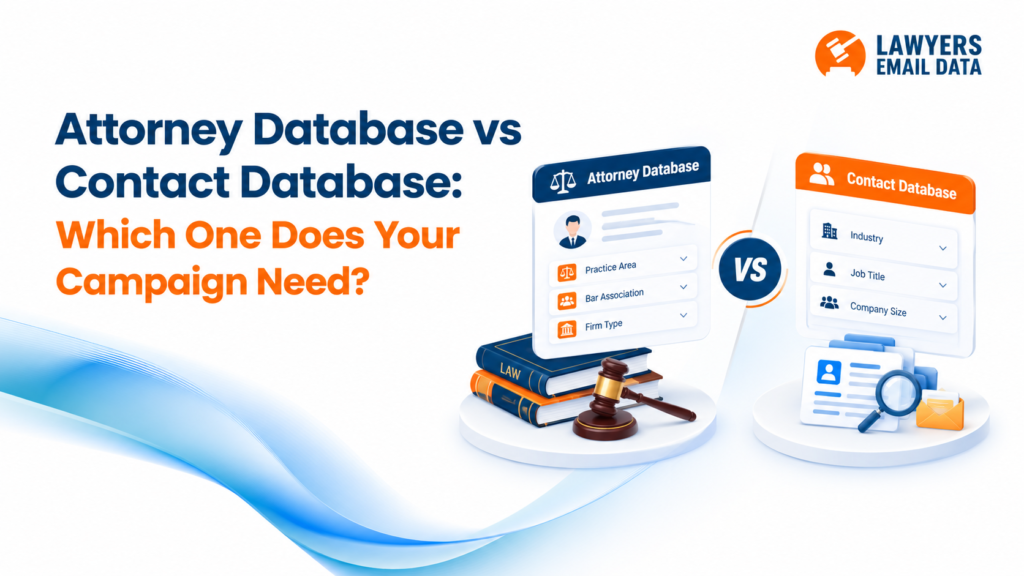
Each contact record is structured around legal-professional fields. That includes practice area, law firm name and type, state bar association, jurisdiction, firm headcount, seniority level, and verified contact details like email and direct phone.
It’s not just a general contact database filtered by job title. The fields are different. The segmentation options are different. It’s designed from the ground up for campaigns where every contact is a legal professional.
Key fields unique to an attorney database include:
- Practice area classification (litigation, corporate, IP, employment, real estate, etc.)
- Law firm name, type, and Am Law ranking
- State bar association and jurisdiction
- Firm attorney headcount and seniority level
- Verified direct email and phone
What Is a Contact Database?
A contact database covers verified professionals across industries. Attorneys are in there, but so are decision-makers in finance, technology, healthcare, manufacturing, and real estate.
The segmentation options use standard B2B fields: industry classification, job title, company size, revenue range, and geography. These work well for campaigns that need cross-industry reach.
So if attorneys are one target segment in a broader campaign, a contact database handles the whole thing from one source. You don’t need a separate dataset for each industry you’re going after.
Both products use verified, regularly refreshed records. The difference is in how the data is structured and what kind of campaign each one is built for.
How They Compare: Side-by-Side
Neither product has an edge over the other in absolute terms. The value comes entirely from matching the format to the campaign.
| Factor | Attorney Database | Contact Database |
|---|---|---|
| Audience scope | Legal professionals only | Multi-industry, attorneys included as a segment |
| Legal-sector fields | Practice area, bar association, firm type, jurisdiction | Standard B2B fields: industry, job title, company size |
| Legal segmentation depth | High: practice area, seniority, firm type, state | Moderate: job title and industry filter |
| Best campaign fit | Legal-only outreach, legal tech, niche legal campaigns | Multi-sector campaigns, attorneys as one target among several |
| ICP fit | Built for a legal-sector ICP | Flexible across industries |
| Cross-industry reach | No | Yes |
| Ideal for | Legal tech vendors, LegalOps tools, compliance software, legal recruiters | B2B SaaS, financial services, HR platforms, multi-vertical agencies |
How to Build a Targeted Attorney Contact List in 5 Steps
Here’s where most campaigns go wrong: they pick a data product first and then try to define the audience inside it. Do it the other way around. Define the audience first. Then choose the product.
Decide If Attorneys Are Your Whole Audience or One Segment
This one question points directly to which product you need. If every contact is a legal professional, an attorney database delivers the legal-sector field depth a general contact database cannot match at the same granularity. If attorneys are one segment in a larger campaign, a contact database covers your full ICP from one source — no need to source and manage multiple datasets. A hybrid approach also works for account-based campaigns where messaging tracks differ completely. Write this decision down before you open any filter. Everything else flows from it.
Apply Firmographic Filters
Firmographic filters define the organizational context of each contact. For attorney outreach, the variables that matter most are firm type (Am Law 100, regional, boutique, solo practitioner, or in-house corporate legal), attorney headcount, state or metro region, and practice area classification. Practice area gets skipped more often than it should — and that’s a costly mistake. Corporate attorneys, litigators, IP specialists, employment lawyers, and real estate attorneys work in completely different professional worlds with different budgets and decision-making structures. An attorney database delivers practice-area filters built into the data structure. A contact database applies firmographic filters using standard B2B classifications — both work, but the attorney database gets you to finer legal-sector segmentation faster.
Target by Job Title and Seniority
Not every attorney at a firm holds the same buying authority. Equity partners and managing partners control purchasing decisions for firm-wide software and vendor contracts. Senior associates can influence adoption internally but rarely sign. General counsel at corporations often manage their own vendor relationships and budgets without firm-partner involvement. Match your seniority targeting to the action you want the recipient to take. If you need a budget decision, target managing partner or general counsel. For awareness or trial adoption, a broader seniority range makes sense. For depth of seniority data within the legal sector specifically, a purpose-built attorney database typically gives you more to work with.
Verify the Data Before You Use It
Attorney turnover is real and persistent. Lawyers change firms, get promoted, transition in-house, or retire. A contact list that was accurate 18 months ago may have a significant proportion of outdated records today. Before any campaign goes live, confirm that email addresses have been validated for deliverability, records have been checked for recency and role accuracy, and duplicate entries have been removed. Ask your provider directly: how often are records refreshed? What verification method is used? Unverified or stale data drives up hard bounce rates, and a damaged sender domain reduces deliverability on every future campaign — not just this one.
Confirm Compliance Before You Source Anything
B2B outreach to attorneys runs under the same legal framework as any professional email campaign. In the United States, CAN-SPAM applies — requiring a valid physical sender address, accurate from-line identification, and a clear opt-out mechanism in every commercial message. GDPR applies for contacts in the European Union. CCPA applies for California recipients. Before you source any data, ask your provider how contacts were collected, whether suppression and opt-out records are maintained, and whether those records can be applied at the time of list delivery. This conversation belongs in the vendor evaluation stage — not after the campaign is already built.
Which One Fits Your Campaign?
Three common campaign scenarios make the decision straightforward.
Selling e-discovery software to litigation partners at mid-sized law firms? Your entire audience is attorneys. You need practice-area filtering for litigation specifically, firm-size control, and seniority targeting at the partner level. An attorney database is the right fit.
Selling compliance solutions to legal, finance, and risk professionals across industries? Attorneys are one segment in a multi-sector target list. A contact database lets you reach general counsel, compliance officers, and risk managers from one source with consistent field structure and unified suppression management. A contact database is the right fit.
Adding attorneys alongside existing finance and operations targets? A contact database gives you the flexibility to add attorneys as a segment without sourcing a separate dataset. As legal grows into a primary target, layering in an attorney database becomes a natural next step. Start with a contact database; consider an attorney database as legal scales.
Common Mistakes When Choosing Attorney Contact Data
-
Prioritizing volume over field depth A contact database with millions of records isn’t automatically better than a purpose-built attorney database with fewer if your entire campaign targets legal professionals. Volume is irrelevant if the segmentation doesn’t match the ICP.
-
Skipping the ICP definition step Both products work well when the audience is clearly defined before data is sourced. Without a written ICP, you end up with a list that’s either too broad to drive pipeline or too narrow to generate enough volume.
-
Treating attorneys as one uniform audience A managing partner at a 200-attorney full-service firm and a solo practitioner running a personal injury boutique are both attorneys — but they’re not the same prospect. Practice area and firm type are the filters that create meaningful segments within the legal sector.
-
Not asking about data refresh cycles Both attorney databases and contact databases go stale. Before any purchase, ask how often records are reviewed and updated. It’s a basic due-diligence question that directly affects campaign performance.
How Our Attorney Data Products Support Your Campaign
Our attorney contact data is available in both formats.
A dedicated attorney database with legal-sector field depth for campaigns where the legal profession is your full audience. And a broader B2B contact database with verified attorney records for campaigns where legal is one segment in a larger push.
Both products are built on verified, regularly refreshed records. Whichever format fits your campaign, the data quality is the same. Match the right format to the right goal. Start with a clearly defined ICP. That combination is where consistent campaign performance comes from.
Conclusion
An attorney database and a contact database are both strong options for reaching legal professionals. The right choice comes down to one thing: whether attorneys are your entire audience or one segment in a broader campaign.
Use the five steps in this guide to define your ICP, apply the right firmographic and seniority filters, verify your data, and confirm compliance before your campaign launches. The right format, matched to the right goal, is where consistent results come from.
Want to See the Data Before You Commit?
Request a sample matched to your target practice area, region, and job titles. Evaluate field depth and record quality before your next campaign.
Request Sample Data Contact Us Today