

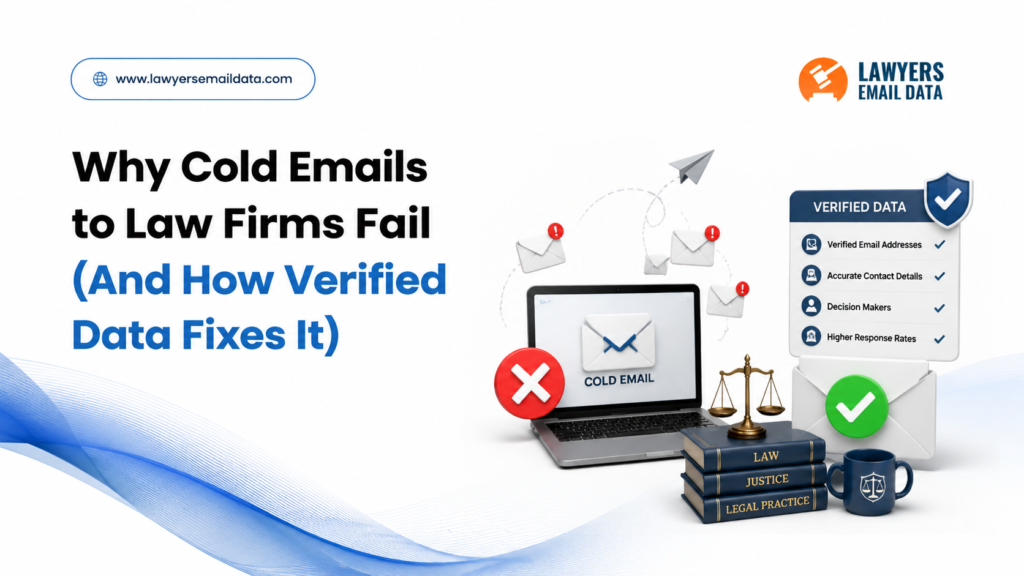
General Counsels and managing partners aren’t ignoring your outreach. Their mail stack filtered it out before it arrived. The copy isn’t the problem. The data is, and stale contact lists cause domain damage that no subject-line test can reverse.
Read the Article ↓Cold emails to law firms generate some of the lowest baseline reply rates in B2B outreach. General Counsels, managing partners, and corporate compliance officers are not ignoring your message because the subject line is weak. They are not seeing it at all.
Their mail stacks have already filtered it out.
Most legal cold email templates in circulation are built for SaaS prospects, not for legal buyers trained to evaluate language for compliance risk and professional intent. And even when a message does land in the inbox, it is being reviewed by professionals who identify poor signals within the first two sentences. A generic template does not survive that review.
Here is the part most sales and marketing teams miss: the copy is not the primary problem. The data is. Stale, unverified contact lists cause hard bounce rates that trigger domain-level blacklisting before a single reply has a chance to come back. Once that damage happens, no amount of A/B testing subject lines will rescue the campaign.
What Is a Verified Attorney Contact List?
A verified attorney contact list is a curated B2B contact file containing confirmed email addresses, firm affiliations, practice areas, and seniority levels for legal professionals. Unlike scraped or static directories, verified lists are maintained through active multi-point confirmation processes that remove invalid or outdated records before the list is used for outreach.
How Did Legal Prospecting Evolve Into an Inbox Battle?
Legal business development shifted from referral networks and print directories to digital outreach over two decades, but most sales teams never updated the underlying assumptions that drive their approach. The legal inbox has hardened considerably since the early days of email prospecting, and the tactics that worked then now trigger immediate rejection from both humans and filtering systems.
A decade ago, attorney contact details were relatively stable. Firms were smaller, partner mobility was lower, and a semi-annual refresh kept contact records reasonably accurate. Outreach at volume generated enough pipeline to justify the method, and the friction in legal inboxes was manageable.
That environment no longer exists.
Law firms now operate inside multi-layer security perimeters configured to filter unverified external senders. Attorneys change firms, move in-house, and retire at rates that render static contact lists obsolete within months of their creation. A list built in January can carry 25 to 35 percent inaccurate or invalid entries by the third quarter of the same year.
The infrastructure of legal outreach has changed completely. The playbooks running on top of it have not.
Why Are Legal Professionals the Hardest Audience to Cold Email?
Legal buyers evaluate every unsolicited message through the lens of professional skepticism. They are trained to identify imprecision, compliance risk, and poor intent, and they apply those same analytical skills to cold email. That professional filtering happens before the firm’s own inbox security infrastructure even gets involved.
Three structural factors make attorneys and law firm decision-makers categorically harder to reach than most B2B audiences:
A General Counsel reviewing a cold email applies the same analytical framework as an attorney reviewing a poorly drafted brief. Generic value-prop-first openers, SaaS-style subject lines, and feature-led pitches are identified as low-quality signals within the first sentence. The message is deleted or reported.
Law firms handling finance, healthcare, government, or intellectual property work deploy aggressive spam filtering, external sender authentication requirements, and domain reputation screening. Senders with high-bounce histories, missing DKIM records, or unverified domains are blocked automatically. Your message never arrives.
Partners lateral to competing firms. Associates transition in-house. Practice groups merge, restructure, or dissolve. Each transition produces an invalid email address on your contact list, and each invalid address pushes your hard bounce rate closer to the threshold that triggers ISP-level penalties.
What Does Bad Contact Data Actually Cost Your Legal Outreach?
According to Google’s Email Sender Guidelines, a hard bounce rate above 0.5% is the threshold at which inbox providers classify a sender as high-risk. Most teams running unverified contact lists to legal audiences exceed that threshold on their very first campaign send, often without realizing it until significant domain damage has already occurred.
The mechanics of the cascade are straightforward. You import a list of 5,000 attorney and General Counsel contacts sourced from a scraped directory or a vendor with infrequent refresh cycles. The list is six months old. Roughly 20 percent of those contacts have moved, retired, or deactivated their professional email address.
Your first campaign returns 1,000 hard bounces. That is a 20 percent hard bounce rate: 40 times the threshold that major inbox providers use to classify senders as problematic.
Gmail and Microsoft’s mail infrastructure register that rate. Your sending domain’s reputation score drops. Subsequent campaigns, even to fully valid and genuinely interested contacts, begin routing to spam folders. Within two or three sends, your domain carries enough negative signals to trigger ISP-level blacklisting.
Domain recovery from this position is not a quick fix. It requires months of careful warm-up activity and often means abandoning the affected sending domain entirely and rebuilding from a new address. The time and pipeline cost of that recovery process exceeds the cost of using verified data from the outset by a substantial margin.
Do not let your next campaign become a domain recovery project. Speak with a specialist about verified legal contact data before your next send, and before the damage is done.
One unverified campaign can burn a domain that took years to build. Speak with a specialist about verified legal contact data before the next send.
Speak With a Data SpecialistHow Does Verified Contact Data Change the Outcome for Legal Outbound Campaigns?
Pre-verified, continuously refreshed contact data removes the bounce problem before it reaches your sending infrastructure. It does not just protect deliverability. It fundamentally changes the targeting precision and contextual accuracy of every email your team sends into the legal market.
The difference between a scraped list and a verified contact file is not cosmetic. It is structural, and it affects every metric that determines campaign viability.
With verified contact records for General Counsels, managing partners, and practice group leads, your outreach operates from a position where:
- Every email address has been confirmed active through multi-point verification on a defined refresh cycle, not collected once and left static
- Hard bounce rates remain consistently below the 0.5% ISP threshold, protecting your sender domain across every campaign and every send
- Contact records include current firm affiliation, practice area, seniority level, and geographic location, enabling segment-specific messaging rather than one-size outreach
- Your email reaches the actual decision-maker: not a defunct account, a shared firm alias, or an attorney who lateraled to a competing firm three months ago
Effective law firm email marketing does not start with better copy. It starts with knowing that the address you are sending to is real, current, and belongs to the person you are trying to reach. Legal decision-makers do not become more receptive to cold outreach because the subject line is cleverer. They engage when the outreach reaches them accurately, respects their professional context, and demonstrates through its specificity that the sender has done real research on their role.
Verified data is what makes that level of precision possible. Every element of the campaign built on top of it performs better because the foundation is solid.
Ready to Build a Legal Outreach Pipeline That Actually Delivers?
Cold email to law firms does not fail because the product is wrong or the pitch is poorly written.
It fails because the contact data underneath the campaign cannot support the send. Stale addresses inflate bounce rates. High bounce rates burn domains. Burned domains make every future campaign less effective, regardless of how well the email itself is crafted.
Fix that one variable, and everything else performs differently. Deliverability holds. Messages reach the actual decision-makers who have the authority to act. Replies become achievable, not aspirational.
Lawyers Email Data provides pre-verified contact records for General Counsels, managing partners, practice group leads, and attorneys across practice areas and firm sizes. Every record is maintained through continuous multi-point verification designed to keep your campaigns off the blacklist and your pipeline moving.
Start with clean data. Request a verified sample today and run your next legal outreach campaign on a list that is built to perform.
Request a verified sample of attorney and General Counsel contacts. See the quality difference before you commit to a full list.
Request Verified SampleLegal Email Outreach: By the Numbers
Six Things a Verified Legal Contact List Gets Right
Every verified legal contact record is built to support segment-specific outreach, protect your sender domain, and put your message in front of the right decision-maker at the right firm.
Multi-Point Email Verification
Each email address is confirmed active through multi-point verification on a defined refresh cycle, not scraped from a directory and left to expire. Hard bounce rates stay below the 0.5% ISP threshold on every send.
Active Refresh Cycles
Attorney contact details change as partners lateral, associates go in-house, and firms restructure. Records are re-verified on rolling cycles so your list reflects current firm affiliations, not last year’s directory.
Practice Area Targeting
Segment by practice area: corporate, litigation, IP, tax, real estate, family law, immigration, and more, so your outreach message aligns with the legal context the recipient actually works in.
Decision-Maker Depth
Filter by seniority: General Counsel, managing partner, practice group lead, partner, associate. Reach the professional with budget authority and purchasing influence, not a shared firm alias.
Geographic Filtering
Target by state, city, or region. Limit outreach to the jurisdictions relevant to your sales territory, event geography, or market expansion plan, and avoid spend on regions you cannot serve.
CRM-Ready Formatting
Every list is formatted for direct import into leading CRM platforms. Contact name, firm, role, email, practice area, and location fields are structured and labeled for immediate campaign activation without manual cleanup.
Frequently Asked Questions About Legal Email Outreach
Practical answers about attorney contact data, bounce rates, verification, and responsible outreach to legal decision-makers.
Law firms handle privileged client communications and operate across highly regulated sectors including finance, healthcare, and government. Security and IT teams treat unverified external senders as an active compliance risk. Domains with high bounce histories, missing authentication records, or low sender reputation scores are blocked automatically before the message reaches any attorney’s inbox.
Hard bounces must stay strictly below 0.5% to maintain a healthy sending domain with major inbox providers such as Gmail and Microsoft. Rates above that threshold trigger throttling or blacklisting at the ISP level. For legal outreach specifically, where professional mobility is high, achieving sub-0.5% bounce rates requires verified and regularly refreshed contact records rather than static purchased lists.
Verified General Counsel and law firm partner contacts are available through specialized B2B data providers that maintain continuous verification protocols for the legal sector. These providers confirm contact accuracy across email address, current firm, title, and practice area on rolling refresh cycles. Static scraped directories and one-time purchased lists lack the ongoing verification that legal sector mobility demands.
Attorney contact details change frequently due to lateral firm moves, in-house transitions, practice group restructuring, and retirement. Based on contact verification cycles across the legal sector, annual churn rates consistently run between 25 and 30 percent of records, making annual or semi-annual verification cycles insufficient for active cold outreach campaigns.
A verified legal contact record should include: confirmed email address, full name, current firm or organization, practice area or department, seniority level such as partner, associate, General Counsel, or managing partner, and geographic location. Records without current firm affiliation and role data produce mismatched messaging and lower engagement rates even when the email delivers successfully.
Legal decision-makers are trained to evaluate language for precision, intent, and credibility. A template built for SaaS buyers signals to a General Counsel that the sender does not understand their role or regulatory context. Effective legal outreach requires verified firmographic data and role-specific messaging, not generic copy applied to an unverified contact list.
A scraped list pulls attorney contact details from public directories without confirming current accuracy. A verified legal contact list applies multi-point confirmation to validate each email address, firm affiliation, and job title at the time of use. For legal outreach, only verified lists reliably keep hard bounce rates below the 0.5% ISP threshold.
General B2B contact lists are not suited for law firm outreach. Legal professionals are categorically harder to reach due to enterprise-grade inbox filtering, high professional mobility, and sector-specific compliance sensitivities. A general list will carry attorney contact records that are outdated, inaccurate, or unverified, producing bounce rates that damage your sending domain before a single reply comes back.
Build a Legal Outreach Pipeline That Actually Delivers
Verified attorney and General Counsel contact data, segmented by practice area, seniority, and geography. Maintained through continuous multi-point verification so your campaigns stay off the blacklist and your replies become achievable, not aspirational.
Request a Verified SampleNo commitment required. Sample data available for qualified B2B outreach teams.