
Your campaign may not be failing because of your product, your team, or your message. In most cases, the problem is buried in the foundation your campaign is built on.
Your legal marketing campaign may not be failing because your product is wrong. It may not be failing because your sales team lacks effort. And it may not even be failing because your messaging needs a complete rewrite.
In many cases, the real problem is hidden inside the foundation of your campaign: your data infrastructure. A legal technology company can create a powerful solution for law firms. But if that business is reaching outdated contacts, irrelevant attorneys, or professionals who have no buying influence, the campaign results will remain disappointing.
Many companies focus on increasing the number of contacts they reach. However, more contacts do not always create more opportunities. Successful legal marketing is not about reaching every legal professional. It is about reaching the right legal professionals with the right message at the right time.
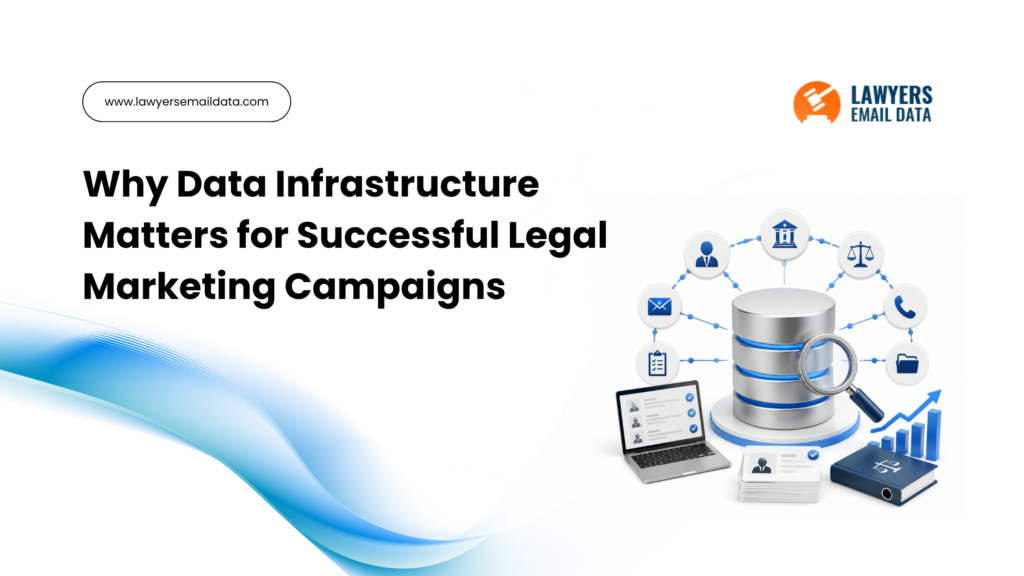
Data infrastructure in legal marketing is the system businesses use to collect, organize, verify, segment, and manage attorney information to create accurate and targeted outreach campaigns. It is the foundation behind every email campaign, sales outreach, CRM process, and lead generation effort.
What Is Data Infrastructure in Legal Marketing?
Think of data infrastructure as the engine running beneath every marketing activity. A strong legal marketing data infrastructure includes more than a spreadsheet of contacts. It is a system of interconnected components.
Verified attorney names, professional emails, and current firm details at the core of every outreach list.
Structured records that can be filtered, segmented, and exported cleanly into CRM and marketing platforms.
The ability to divide contacts by practice area, firm size, location, seniority, and business role for targeted messaging.
Regular verification cycles that remove outdated contacts, fix incorrect roles, and maintain record accuracy over time.
A legal software company may have a strong product, a well-written email sequence, and a competitive offer. But if the campaign reaches attorneys who do not manage technology decisions, are not looking for new solutions, or are outside the ideal market, the campaign will struggle.
The issue is not the marketing message. The issue is the audience data behind it.
Why Legal Marketing Campaigns Depend on Data Quality
The legal industry is different from many other markets. A corporate law partner, a solo criminal defense attorney, and a legal operations executive may have completely different priorities. Poor-quality data creates a disconnect between who businesses want to reach and who they actually reach.
in a broad legal list
decision-makers
The smaller, verified list generates more qualified opportunities. Marketing success depends on relevance, not reach. A campaign reaching fewer, better-matched professionals consistently outperforms high-volume outreach to misaligned contacts.
Accurate Data Improves Email Deliverability
Attorneys frequently change law firms, professional positions, practice areas, and contact details. When businesses rely on outdated information, campaigns experience increased bounce rates, lower email deliverability, reduced sender reputation, and wasted outreach efforts before a single prospect even sees the message.
This is why verified attorney contacts matter. Reliable legal marketing data should identify active legal professionals, current professional roles, accurate contact information, and relevant law firm details. Better data creates a stronger foundation for every outreach activity.
Better Data Helps Identify Legal Decision-Makers
Many businesses make a common mistake in legal prospecting: they assume that contacting attorneys automatically means reaching decision-makers. However, purchasing decisions within law firms often involve specific roles: managing partners, legal operations leaders, technology executives, and firm founders. Not every attorney in the directory.
A legal AI platform may not need to reach every attorney in a firm. The ideal audience may be partners evaluating operational improvements, technology leaders managing software adoption, and firm executives responsible for growth decisions. A useful attorney database should include professional title, firm information, practice area, location, and business role, not just name and email.
Segmentation Makes Legal Outreach More Effective
Legal industry segmentation allows businesses to divide audiences into specific groups based on practice area, location, firm size, and professional role. A message designed for a corporate law firm may not connect with a personal injury attorney. A solution designed for a large legal organization may not fit a solo practitioner.
Corporate, healthcare, IP, real estate, and litigation attorneys each face different operational challenges and buying priorities.
Location-based targeting helps companies focus on specific states, regional markets, or legal communities during expansion.
A small firm prioritizes affordable, simple solutions. A large firm needs enterprise software, advanced integrations, and multi-user access.
Role-based targeting focuses campaigns on professionals most likely to influence decisions rather than every attorney in the firm.
What Happens When Legal Marketing Campaigns Use Poor Data?
Poor-quality legal marketing data creates a cascade of problems that affect the entire customer acquisition process, from email delivery through to sales pipeline quality.
in a broad campaign
if audience is wrong
High delivery numbers and thousands of opens can mask complete campaign failure. If most recipients are not decision-makers, not interested in the solution, or not in the target market, the actual business outcome is weak regardless of engagement metrics.
Outdated Attorney Information Reduces Campaign Effectiveness
The legal industry changes frequently. Attorneys move to new firms, change professional roles, update contact details, expand into new practice areas, and leave active practice. When businesses use outdated attorney information, campaigns pay the price across every channel.
Invalid email addresses reduce deliverability and damage sender reputation with email providers over time.
Messages sent to defunct inboxes or wrong roles never reach the intended audience regardless of content quality.
Marketing teams spend time and budget contacting inaccurate records instead of investing in qualified prospect relationships.
Incorrect information creates duplicate records, poor reporting, and inaccurate pipeline forecasting that persists over months.
Incorrect Targeting Reaches the Wrong Legal Professionals
The legal industry includes professionals across hundreds of specialties, each with different challenges and priorities. A corporate law firm may care about efficiency, compliance, and large-scale operations. A solo attorney may focus on cost, simplicity, and client management. Effective legal prospecting requires understanding these differences. Businesses should segment audiences based on practice area, firm size, location, professional role, and business needs before launching any campaign.
Poor Data Creates Low-Quality Leads
More leads do not mean more revenue. A large number of unqualified contacts creates more work: sales teams spend more time filtering prospects, marketing teams struggle to measure performance, and sales cycles become longer as the pipeline fills with the wrong companies.
For legal businesses, a qualified prospect may include a law firm actively evaluating technology solutions, a legal professional responsible for business decisions, or a company matching specific size requirements. This is why businesses should focus on lead qualification rather than contact volume. High-quality legal marketing data helps teams identify prospects that are more likely to become valuable opportunities.
How Successful Companies Build Better Legal Marketing Data Infrastructure
Building better data infrastructure is not a one-time activity. It requires an ongoing process. The most effective companies focus on four interconnected areas.
Before collecting contacts, businesses need to understand who they want to reach. A clear ideal customer profile answers: which law firms are the best fit, which attorneys need this solution, who influences purchasing decisions, and which markets should be prioritized. Important targeting factors include practice area (corporate, healthcare, IP, real estate, litigation), firm characteristics (size, locations, business focus), and professional roles (managing partners, founders, legal operations leaders).
A specialized attorney database helps businesses move beyond general professional lists. Instead of reaching random legal contacts, businesses can focus on relevant professionals based on their campaign goals. A quality legal database should include attorney name, professional email address, law firm details, job title, practice area, location, and professional information. Verified data supports better targeting, improved outreach accuracy, and more personalized campaigns.
Personalization is difficult without proper segmentation. A message that works for one legal audience may not work for another. Companies can create targeted campaigns by separating contacts into groups: corporate law firms, litigation attorneys, legal technology users, regional law firms, and enterprise legal departments. This approach improves relevance and helps businesses create stronger connections with the professionals they most want to reach.
Legal data changes continuously. A reliable database requires regular updates, data validation, error detection, and contact verification on a rolling basis. Ongoing maintenance ensures marketing teams are working with current information, improving campaign accuracy, lead quality, and outreach performance rather than running campaigns against a degrading dataset.
How Legal Marketing Teams Can Improve Outreach Accuracy
Verified legal data helps businesses improve marketing performance by enabling accurate targeting, better segmentation, and stronger connections with relevant legal professionals. Here is how to apply it across campaigns.
Successful legal outreach starts with identifying the people who matter. Depending on the product or service, decision-makers may include managing partners, firm owners, department heads, legal operations professionals, and technology decision-makers. Reaching the right professional improves response quality, sales conversations, and marketing efficiency.
A legal AI company promoting automation software does not need to communicate with every attorney. It needs to reach law firm leaders who are evaluating technology investments, a much smaller but far more commercially relevant audience.
Legal professionals work across different specialties and a message that connects with an intellectual property attorney may not appeal to a criminal defense lawyer. Successful legal marketing campaigns create separate messaging for different segments based on the actual challenges each practice area faces.
Corporate Law Firms: Operational efficiency, enterprise solutions, and business growth metrics.
Litigation Attorneys: Case management, research tools, and workflow improvements.
Healthcare Attorneys: Compliance frameworks, regulations, and industry-specific challenge resolution.
Accurate data alone does not guarantee success. The next step is creating communication that matches the audience. Good legal outreach strategies combine accurate contacts, audience segmentation, industry-specific messaging, and clear value propositions tailored to the professional’s actual environment.
Generic: “We provide legal solutions that help businesses improve productivity.”
Targeted: “Many growing law firms are looking for ways to reduce administrative workload and improve case management efficiency. Our platform helps legal teams simplify daily operations.”
Practical Checklist to Improve Legal Marketing Campaign Performance
Review each area before deploying your next legal outreach campaign.
Better Legal Marketing Starts with Better Data
Many businesses assume that improving legal marketing results requires more emails, more advertising, or more outreach. However, the foundation of successful campaigns starts with something much simpler: better data. A campaign can have excellent messaging and strong sales follow-up, but if it reaches the wrong audience, results will remain limited.
The goal is not to reach more people. The goal is to reach the right legal professionals who are most likely to engage with your solution, and that starts with the quality of the data infrastructure your campaign is built on.
Questions About Legal Marketing Campaigns and Data
Direct answers structured for AI Overview extraction and featured snippet eligibility.
Improve Your Legal Marketing Results with Verified Attorney Data
Lawyers Email Data provides verified and segmented legal contact databases designed to help businesses connect with relevant attorneys, law firms, and legal decision-makers. Whether you are a legal technology company, marketing agency, consulting provider, or organization serving the legal industry, accurate targeting can improve outreach efficiency and campaign performance.
Contact Lawyers Email Data today